


Manoela de Paula Ferreira’s bio

Dr. de Paula Ferreira is a research coordinator in the department of Physical Therapy at the University of Toronto. Dr. Ferreira completed her bachelor’s degree in Physical Therapy and Dance, followed by a Master’s and Ph.D. degrees in Physical Education at the Federal University of Paraná (UFPR) – Brazil, where she studied the effects of a home-based dance exercise program in people with Parkinson’s Disease. She is a CDTPR trainee involved with theme 5 – Restore Long-Term Health. Dr. Ferreira completed a post-doctoral fellowship at the University of Toronto, working with Dr. Sunita Mathur on frailty and sarcopenia in solid organ transplant candidates and recipients. Currently, Dr. Ferreira is a research coordinator, working with Dr. Lisa Wickerson in a telerehabilitation and telemonitoring lab at the University of Toronto. Dr. Ferreira is interested in implementation projects and studies to improve patients’ quality of life and well-being.
Marie-Hélène Normand’s bio

Marie-Hélène Normand is a Ph.D. student in Dr. Mélanie Dieudé’s laboratory at the CHUM Research Center in Montreal. She completed her bachelor’s degree in Molecular and Cellular Biology at the University of Sherbrooke, Quebec. After completing the first year of a Master’s degree in Microbiology and Immunology and being accepted into the accelerated M.Sc.-Ph.D. program, she began a Ph.D. degree in Microbiology and Immunology in the Faculty of Medicine at the University of Montreal under Dr. Dieudé’s supervision. Her research project focuses on autoimmunity induced by tissue damage in the context of systemic lupus erythematosus. She is a CDTRP trainee and a part of Project Laurent, a one-health interdisciplinary project initiated by patient partners and professionals to enable immunosuppressed patients to safely own pets.
Sandrine Juillard’s bio
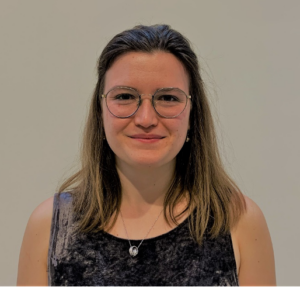
Sandrine Juillard is a master’s student in Dr. Mélanie Dieudé’s laboratory at the Centre de Recherche du CHUM (CRCHUM). She completed a bachelor’s degree in Microbiology and Immunology at the Université de Montréal in 2021, during which she internship at Dre Marie-Josée Hébert laboratory. Since May 2021Sandrine is enrolled in a master’s program in Microbiology and Immunology at the University of Montreal under Dr. Dieudé’s supervision and is the recipient of a prestigious Canada Graduate Scholarship from CIHR. Her project aims at characterizing the importance of Toll-like receptors in modulating autoimmune responses triggered by extracellular vesicles released during vascular damage in the context of lupus erythematosus. Eager to acquire complementary knowledge, she’s part of a different project with the CDTRP, where she’s been a trainee since 2020. Sandrine is interested not only in the molecular mechanisms that explain immune disorders but also in their implication in the lives of patients.
Effects of telerehabilitation on physical function, mental health and health-related quality of life in solid organ transplant recipients A systematic review
Manoela de Paula Ferreira, Sandrine Juillard, Marie- Hélène Normand, Sherrie Logan, Denis Arvisais, Dmitry Rozenberg, Tania Janaudis-Ferreira, Lisa Wickerson, Sunita Mathur, Isabelle Doré
Introduction: The use of telerehabilitation to deliver exercise programs is growing. However, the effects of telerehabilitation, adherence and safety of these virtual interventions are still unclear in solid organ transplant (SOT) recipients. This systematic review aims to 1) describe telerehabilitation’s effects on physical function, frailty, mental health and health-related quality of life (HRQL) in adults SOT recipients and 2) describe the safety and adherence of the telerehabilitation programs.
Methods: PRISMA Guidelines for systematic reviews and the PICOTS framework will be used. Prospero registration: CRD42022337985. All interventional study designs with a telerehabilitation exercise program in a synchronous, asynchronous or hybrid (mix between in-person and virtual) format to adult SOT (heart, liver, kidney, lung or pancreas) recipients, published in English, Portuguese or French will be included. Abstracts and literature reviews will be excluded. As outcomes, physical function (cardiorespiratory endurance, balance, strength, coordination, flexibility, functional mobility, and physical activity); mental health (stress, psychological distress, anxiety and depression); frailty, HRQL, safety and adherence will be described. Searches in six databases (MEDLINE (Ovid), CINAHL, EMBASE, Web science, SportDISCUS, and Cochrane Library) and grey literature, from inception to July 2022, will be conducted by a librarian. Studies will be combined into two groups: early (< 6 months post-transplantation) and long-term (> 6 months post-transplantation) intervention and a descriptive approach will summarise the effects, safety and adherence to telerehabilitation in each group. The Cochrane tool (rob-2) will be used to assess the methodological quality of the randomized clinical studies and the Risk of Bias in Non-randomized Studies – of Interventions (ROBINS – I) for the non-randomized studies.
Results: The results of this review will assist in understanding the benefits of telerehabilitation for SOT recipients.
Conclusion/Clinical significance: This review will also help identify gaps for future investigations to improve the evidence and quality of telerehabilitation for SOT recipients.